pre-design: IN PLAIN SITE

FEBRUARY 2024, ISSUE 2

“You cannot simply put something new into a place. You have to absorb what you see around you, what exists on the land and then use that knowledge along with contemporary thinking to interpret what you see.”

Tadao Ando, Architect

segment of USGS Quadrant Map

Several tasks routinely take place prior to the architect’s involvement. For that reason, these tasks are referred to as pre-design. That is not to say that the architect will not or should not be involved in these early tasks, only that it is typically not part of the architect’s scope of work.

I’ll start by stating what I believe to be plainly obvious: The most important pre-design tasks deal in some way with the building site. As we’ll explore further in the next installment, Parti’ Time, the selection of the site, more than any other factor, defines the architecture. The slopes, the views, the positions of the sun, the proximity to boundaries and neighbors, all of these site-related factors, can influence how the house will be arranged, planned, and formed. Having said that, It is not a given that the site will be inform the house design. Houses are commonly designed with no regard to their site, if they even have a site when designed. Such a house may provide adequate shelter and may even exhibit nice features; however, it will not reach its full potential. It may be shelter, but it unlikely to rise to the level of “big-A” Architecture.

Finding the right site is hard! I empathize with my clients who genuinely struggle to find the perfect site. Once Susan and I decided that we wanted to build, as discussed in the An Origin Story post, we were faced with a couple of significant questions – What? And Where? The What will be answered in future posts, The Where is addressed here.

Susan and I knew that we wanted a couple of acres somewhere along the Little River. I was thinking of the West Fork, and the first site we found was on the West Fork, just north of Mentone. It was a beautiful site that sloped gently to the river. It had a nice mix of hardwoods and pines, as well as some beautiful native rhododendrons. Strangely, there had been very little development in this area, at least near the river. As it turns out, even though Little River runs on top of Lookout Mountain, it floods periodically and the majority of this site was in the floodway! We also learned that the nearest waterline was a half mile away. Strike 1…..and lesson 1: Do your due diligence!

Next we found some property along the East Fork. I had persued the West Fork because I thought the East Fork was too narrow and would more closely resemble a stream. When we visited the area I was happy to be completely wrong. Below Lake Lahousage the East Fork was every bit as striking as the West Fork. And from all indications, the Owner was ready to sell, offering to throw in lot 4 along with lot 5. Who can resist a BOGO? The only problem was that one had to cross a ravine to get to lot 5. Access was just a hard hike by foot but would be too steep for a car, not to mention a cement truck! I called in a sitework excavator who gave me a jaw dropping estimate for the labor and materials required to cross the ravine and another site was eliminated. Strike 2…..and lesson 2: Make sure your site is accessible!
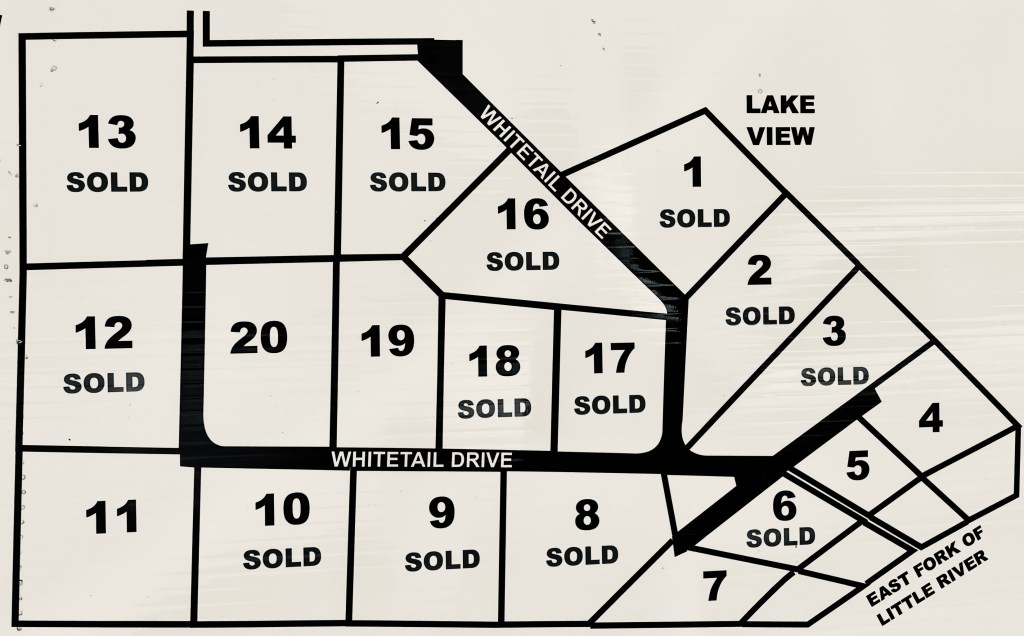
Realtor’s Map of the Subdivision

We didn’t know it at the time, but what became our actual building site was just a couple hundred feet downstream, Lot 7. This site was the most beautiful of all we had seen. It had good vehicular access and sat high above the floodway. It was relatively flat near the gravel entrance road but steep as it neared the river. Utilities were close by and could be made to work without too much trouble. So, after a little more due diligence, we contacted our Realtor and made it happen. It was the perfect site for us and our needs . Homerun!

Putting on my architect’s hat for a minute, I can tell you that rarely has a client come to me without having already secured their building site. That’s too bad. I think that architects can offer a lot of useful insights into the site selection process. If you do select the site, just make sure you check all of the possible restrictions – floodways, sloped development, zoning, neighborhood HOAs, and the like.

Home Owner Associations covenants are often overlooked but can have a big impact on the design of the house, particularly if you want a compact design or if your aesthetics lean contemporary. In the case of the dinky House, the site we purchased is in a “neighborhood” which did have covenants. This caused some hiccups since the convenents required that the house be 1,130 square feet or larger (I’m not sure how they arrived at that number.) After doing some early schematic design, I felt I could get everything we needed in about 900 square feet. Susan felt we needed more space so that we could house more people (grandchildren really!). Of course she was right, and the “dormitory” was born, which got us over the square footage hump. Fortunately there were no objectionable design restrictions, as our taste leans contemporary.

I should point out that if you finance your project through a lender, you may need to provide a fair amount of up-front information. In addition to financial statements you’ll likely need either a bid or a good faith estimate from a builder. Obviously that requires knowing who your builder will be before your house is even designed, or it requires that you work with the architect at least through the schematic or design development phases. That can be pricey if you’re not certain that you want to build. This is a chicken-and-egg dilemma – the first of many.

Every project will have its own unique pre-design tasks. This post highlighted some of ours. Hopefully it has shown that the site, and all of its parameters, are of paramount importance when one is considering building a house. Since I happen to be an architect, I didn’t really have to decide when to reach out to an architect. Assuming that you’re not an architect, you’ll want to start out by really thinking through what kind of house you want and roughly what you’re willing to spend to get there. Your architect can help you flesh these things out as the design is developed. That’s the topic of the next post, Schematic Design: Parti’ Time.

BONUS Material:

If you look carefully at the Realtor’s map, you’ll notice a line running parallel with the Little River which bisects lots 4, 5, 6, and 7. This caused a great deal of head scratching. Was it a property line? Was it a building setback line? Neither our realtor nor the selling agent knew what it was. Eventually I found out in conversation with a local sitework excavator, and later his story was retold by the civil engineer of record for the subdivision. The line identified the location of the dinky Railroad, which inspired the name “dinky House,” now affectionately known simply as “the dinky”.

prequel: AN ORIGIN STORY

JANUARY 2024, ISSUE 1

“….. imagine a dinky house sprouting out of a small site on the Little River.” 

– Darryl Bird, Architect (and half of a client)

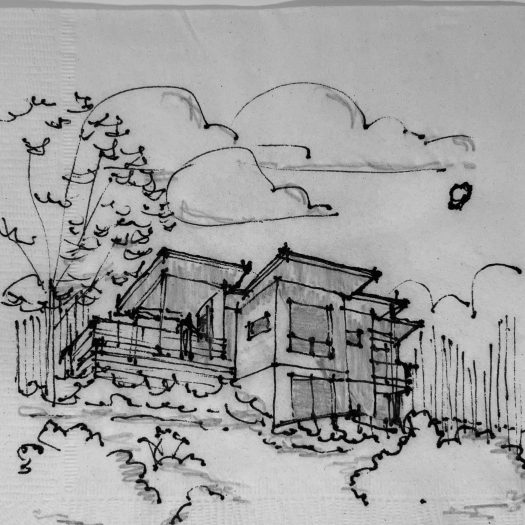
a napkin sketch of the dinky House as viewed from the dinky line

My wife and I were traveling back to Huntsville from a visit in Charleston when, out of the blue, she posed a hypothetical question. I try very hard to avoid these kinds of questions, but there was not getting out of this one, since I was stuck in the driver’s seat. She said, “What would you do if you had a million dollars?” I tried to explain that it really didn’t matter, since I did not have a million dollars…and neither did she. It didn’t work. I needed an actual answer…..so I racked my brain.

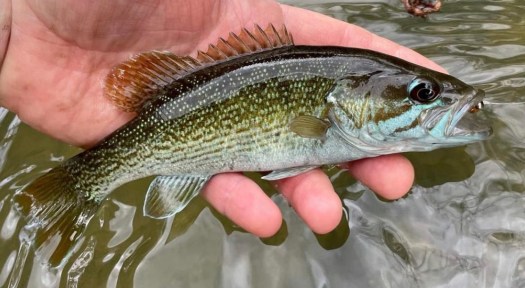
Over the years I have developed a passion for fly fishing. It’s about the fish, but it’s also not about the fish. Trout are discriminating creatures and they live in only the most scenic of places. The beautiful rivers and streams they inhabit are often remote, but I like that. I enjoy the journey. Then there’s the fishing. Fly fishing forces one to slow down, decompress, and focus on the cadence of casting. This is a welcome respite from the rigors of my profession, architecture. And, of course there is the occasional thrill of the catch. Trout were the only fish I had chased, with one exception – the redeye bass. These colorful little fish, like trout, thrive in beautiful rivers and streams. Unlike trout, however, these fish are primarily found in Alabama. These fish were on my mind as we were traveling along Lookout Mountain and nearing the Little River – the only US river that runs its full length atop a mountain. It is was in this river, specifically in DeSoto State Park and later in the Little River Canyon, that I managed to wrangle in a couple of five or six inch redeye bass!

Redeye Bass are rare, but common to the Little River

“I’d build a fishing cabin on the Little River,” I finally replied. She smiled, paused for a moment, then said, ”We can do that.” Surprised, it was my turn to pause. We then began to unpack what had just taken place. Was she serious? Was I serious? Before we knew it we were in Fort Payne. There, we pulled off at “The Spot”, a local coffee shop. The discussion started to flesh out. At the counter we picked up a copy of the Groundhog, the “paper” of nearby Mentone, and started looking for river lots. By then, we could imagine a dinky house sprouting out of a small site on the Little River. To make a long story short, I never received a million dollars, but Susan still figured out a way for us to journey from imagination to reality, all in about eighteen months.

The small fishing cabin, which we affectionately call the dinky House, is now complete…..mostly. We are at the point of wrapping up the construction punchlist while also furnishing and accessorizing it. Periodically, during the process of design and construction, I thought about how this project would be a good case study to explore on my We Shape Space blog. I now feel increased empathy for my clients who are at the beginning stages of the process. Even though, as an architect, I have been through this process many times, it is somehow different when you are also the client (or half of the client). It is truly a roller coaster ride, both thrilling and exhausting. I’m looking forward to sharing my insights and perspectives through this blog. Over the next few months I’ll discuss the various phases of design (schematic design, design development, construction documents, and procurement), as well as the various phases of construction (from coming out of the ground to the final punch list). Hopefully I can offer some unique insights and make the journey less daunting for those who get on the roller coaster. It is my intention to put out a new blog post near the end of each month. I’m already thinking about the next post of the dinky Chronicles in February: Predesign – In Plain Site.

BONUS Material:

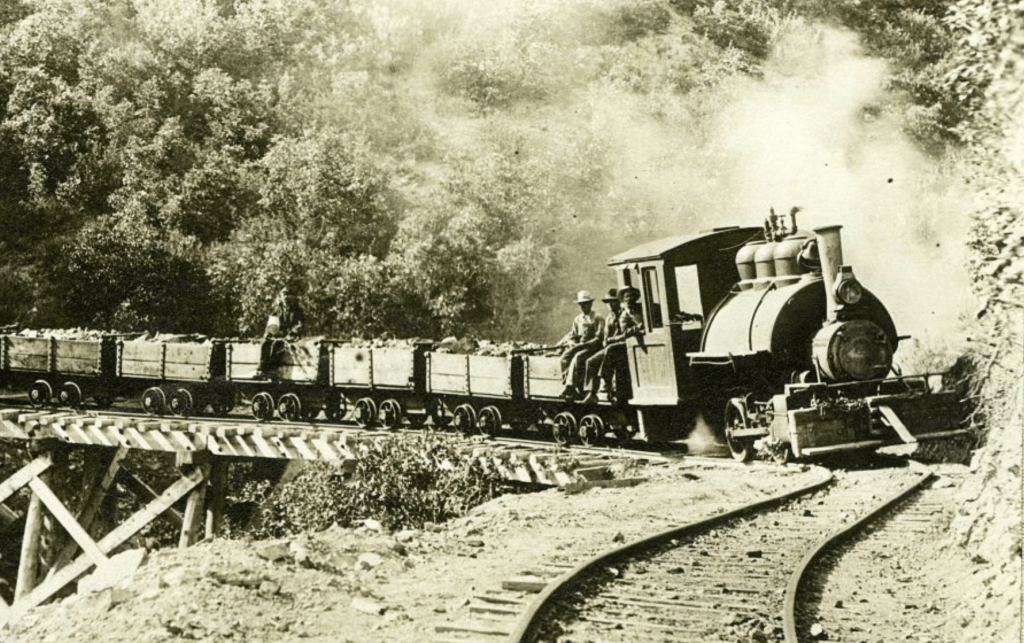
The name “dinky House” has a dual meaning. One, obviously, is that it is a small house. At less than 1200 SF it is larger than a “tiny house” but less than half the size of the average American home in 2023. The less obvious meaning is a bit harder to explain. There is a flat strip bisecting the site, through which a narrow gauge railroad ran, just after the turn of the twentieth century. The train hauled coal along the Little River, crossing it a few hundred feet away from what is now our site, and eventually delivering it in nearby Georgia. The locals affectionately dubbed it “the dinky line”. A house looking over the dinky line would logically be a dinky house, wouldn’t it?

a “dinky” railroad carrying coal

Phases of Architectural Services

Architectural projects involve several steps, or phases of service. Typically, full-service projects go through the following five phases. In some cases, these phases overlap and occasionally there may be additional ones. The following descriptions should provide you with a general understanding of what you might expect.

Should you desire additional information, check out THE dinky CHRONICLES, on this same blog. I take the reader a bit more methodically through the process of designing and building a house, dwelling on a different phase in east issue. The series uses a small house (or rather, a dinky house) as a case study.

SCHEMATIC DESIGN PHASE (normally 15% of fee)

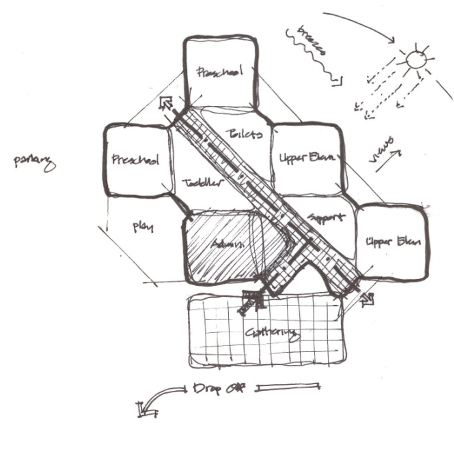
The owner and architect discuss the requirements for the project (identify required spaces, their function, etc.), testing the fit between the owner’s needs, wants, and the budget. The architect will need your site survey and consult with governing authorities with respect to the building and zoning codes, as they apply. In collaboration with the owner, the architect prepares a series of rough sketches. These schematic design sketches show the general arrangement of rooms and the positioning of the building on the site. These sketches evolve over multiple meetings. The owner approves the general concepts presented in the sketches before proceeding to the next phase.

DESIGN DEVELOPMENT PHASE (normally 15% of fee)

The architect prepares more detailed drawings to illustrate other aspects of the proposed design. Floor plans show all the spaces in the correct size, shape, and relationship. The architect may supplement the sketches with computer generated models that aid in visualization. Decisions are made regarding the major systems, materials, and finishes. A budget is developed by the architect based on his experience and cost estimating guides. A timeline for the project is also established. The architect will make a good faith effort to align the project and the budget. The true cost of the project remains uncertain until the project is bid or negotiated.

CONSTRUCTION DOCUMENTS PHASE (normally 40% of fee)

Once the owner has approved the design and budget, the architect prepares detailed documents, which the contractor will use to establish the actual construction cost and to build the project. These documents include the construction drawings and the project manual, including specifications. The documents may include landscape architecture, civil, structural, plumbing, fire protection, mechanical, and electrical documents. Occasionally they may include deliverables by the owner’s or architect’s specialized consultants. These construction documents become part of the contract between the owner and the contractor, and are also used by the contractor to obtain a building permit.

PROCUREMENT PHASE (normally 5% of fee)

The owner selects and hires the contractor. The architect will assist the owner and make recommendations as appropriate. In many cases, the owner chooses from among several contractors asked to submit bids, based on the construction documents. In other cases, the owner may choose to negotiate with a specific contractor. In either case, the architect will prepare the bid documents, which may include invitations to bid, instructions to bidders, and the like. After the contractor is selected, the architect will prepare the agreement (contract) between the owner and the contractor.

CONSTRUCTION PHASE (normally 25% of fee)

While the contractor will physically build the project, the architect will assist the owner in making sure that the project is built according to the construction documents. The architect will make site visits to observe construction, help the owner review and approve the contractor’s applications for payment, and generally keep the owner informed of the project’s progress. The architect follows the project through completion, prepares punch lists, and determines when the project is substantially complete. The contractor is responsible for construction methods, techniques, schedules and procedures, as well as obtaining the signoffs from inspectors. The owner is responsible for project financing and timely payments. This is the classic triangular structure of responsibility that has the checks and balances necessary for the successful completion of the project.

Since each of clients are unique, each phase of every project yields unique results. Our creativity and experience allow Arcspace Studio to literally shape space, resulting in projects which exceed our client’s high expectations!

the Tagline

The Tagline is the third and final post in our behind-the-scenes trilogy of our firm’s rebranding efforts. The more I learned about branding during this process, the more I appreciated the advantages of having a good tagline. The blogger Lindsay Kolowich had a great explanation of the tagline (which she referred to the slogan): “While logos are visual representations of a brand, slogans are audible representations of a brand.” In the case of ARCSPACE STUDIO, I wanted our tagline to represent, in the simplest terms possible, just what our firm does.

As opposed to the mental challenge of coming up with a new firm name, and the significant effort involved in designing the logo, the tagline came to me rather easily. I had already burned a lot of brain cells thinking about the brand before confronting the tagline. In particular, I spent a lot of time thinking about two types of space.

One of these types of space might be called “architectural space”. On a basic level, all architects design buildings that contain space; however, I would contend that truly creative architects design buildings that go further, and they actually shape space. That is what the architects and designers at ARCSPACE STUDIOS do…we shape space.

ArcSpaceStudioTAG

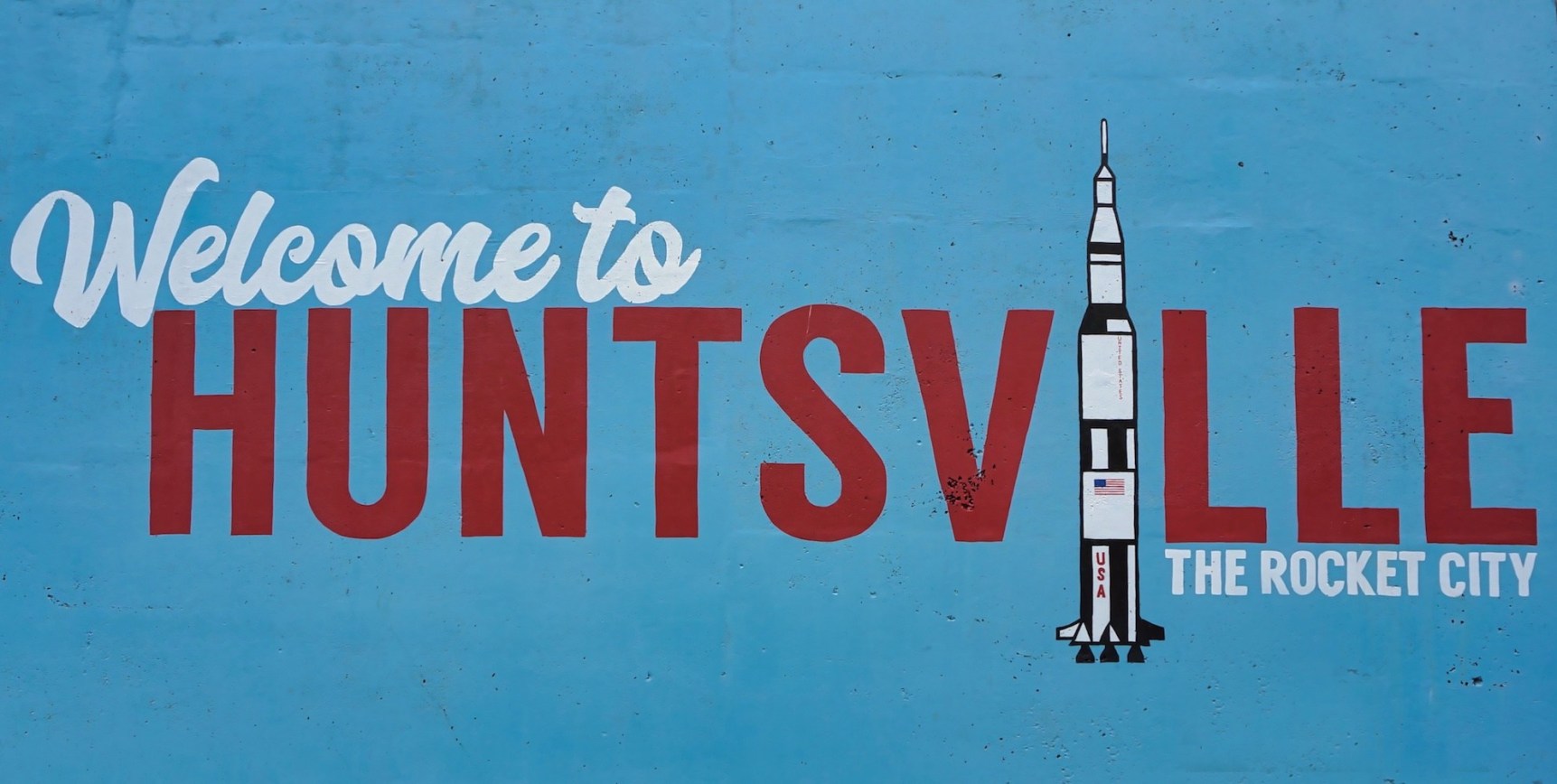
The other type of space is “the final frontier” kind of space. The space program, and the industries it spurs, underpin the region in which we practice. So in a very literal way, when we shape space, we are shaping our community.

Huntsville-Hero
A wall mural in Big Springs Park welcomes visitor and reminds them that Huntsville is The Rocket City!

Now…Switching gears back to graphic design, by adding the Tagline to the Logo and the Name, we had successfully completed the branding identity trilogy. Now, it was just a matter of putting it all together, followed shortly thereafter by putting it on everything! Similar to Portlandia’s “put a bird on it”, we put our brand identity on letterheads, title blocks, project manuals, and even stuff like tumblers, shirts, and hardhats. In fact, if you’d like a free ARCSPACE STUDIO sticker, let me know and I’ll put it in and envelope and send it to you via snail mail.

ArcSpaceStudioFINComboLogo.png
Stick with ARCSPACE STUDIO!

In future posts I will use some of our design projects to demonstrate just how ARCSPACE STUDIO shapes space. The services architects offer involve several phases of design. An overview of this is presented in the aptly named Phases of Architectural Sevices post. I hope you’ll subscribe and join me in this exploration!

the Name

I was recently interviewed by a prospective client. His first question had nothing at all to do with our work, our approach, or our qualifications. His first question was “How did you come up with the name Arcspace Studio?” I answered forthrightly with various reasons that popped into my head, but that moment was a bit of an epiphany – a name is not just important, it’s really important!

Traditionally, architecture firms are named after the partners, frequently in alphabetical order. In 1998, when Greg Kamback and I founded our firm, it was natural to land on the name Bird & Kamback Architects. When we decided to rebrand in 2019, the naming (or renaming) of the firm proved to be much more difficult. For me, it was the most difficult part of the rebranding process.

After exploring and discIMG_0608arding innumerable names, I noted that there were some words I was really drawn to. We are an architecture firm, so it seemed to me that this was a word that should be used. This word unfortunately has the drawback of being really long, especially when combined with other words. Space was a another word that I really wanted to use. At first I seriously considered the name Space Architects; however, this seemed to conjure up images of space stations rather than of buildings. Space has a double meaning for me. Obviously it is the primary medium of the art of architecture, but space also nods to my adopted hometown. If you know anything about Huntsville, you know that we are steeped in the space program. It began with Werner VonBraun and the space race, and its influence is still with us. Evidence is visible through the Space & Rocket Center, NASA, Redstone Arsenal, and numerous other space related eventures.

IMG_0605At some point it occurred to me to fuse the two words into one. I flirted with simply naming the firm ….. Arcspace. I also considered naming the firm Arcspace Architecture (although the redundancy sounded redundant). In both cases the names, and the domain names, were taken. I then considered Arcspace Atelier, Arcspace Firm, and Arcspace Studio. I really liked the alliteration of Arcspace Studio. Like some of my previous name ideas, I test drove the name past my wife, Greg, and a couple of friends. They all claimed to like it, and this time, without a pause. I finally had it!


Another benefit of the name Arcspace Studio is that it shows up at or near the beginning of lists arranged in alphabetical order. Being a “Bird”, I know the benefits of being at the front of the line.  Arcspace Studio also sounds a lot better than A1 Architects. (Believe it or not that name is taken as well.)

Finally, I engaged my talented office manager/graphics guru, Jennifer, to help me advance the graphic identity of our name and marry it with our logo. After considerable effort we landed on the appropriate font, stroke thicknesses, and colors coordinating with the logo. We tweaked it even more through lining and kerning until we had a pairing of name and logo at a professional level.

ArcSpaceStudioFINComboLogo

Now, back to my interview story. After my wordy but seemingly insufficient explanation of my firm’s name, my prospective client thought and said, “Well, I like it. It’s memorable.” Nice. That’s what I needed to hear!

So, that is the story of our firm’s name and its integration into our brand’s identity. While I was pleased to have designed the firm’s logo and determined firm’s name, there was one other part of our brand’s identity still looming. I needed a tagline. That too has a story….

the Logo

Since the day our firm “rebranded” in January, those of us at ARCSPACE STUDIO have heard numerous questions and comments regarding this change. Most first noticed the change in the new logo, name, and tagline. For those clients, colleagues, as well as the merely curious, I thought I’d provide some insight. At the same time, this gives me a good way to launch the we shape space blog. Let’s start with the Logo.

BK logo - boxBack in 1998,  we opened our doors as Bird & Kamback Architects. One of my early tasks was designing a logo. I pulled together a simple logo, using stylized versions of our initials placed in a red box. I then placed the logo beside our name and printed stationary and business cards. And that was that. At the time, I did not fully appreciate what a brand really entailed, nor how engrained it would become.

The firm’s twenty year milestone provided us with an opportunity to rebrand. This time I pursued the process with the appropriate seriousness. I read books and blogs and watched numerous videos. I learned that the most effective logos are very much like good architecture – they are simple in form but convey a depth of meaning.

Although architects design buildings, I began to notice that many architecture firms relied on logos that played off of their initials (like the old Bird & Kamback logo), were inspired by the T-square or drafting compass (which few architects still use), or contained an ancient building component (of which the column reigned supreme). In my case I was determined to design a logo that recalled a building. I did not want it to be too literal or an actual building that we had designed. I also did not want it to read as either a house or a commercial building, since our firm does both. Figuring out how to represent something as simple as a building proved to be more challenging than I could have imagined.

feiJ+DuATa2As0uEO1PLeg_thumb_31b0

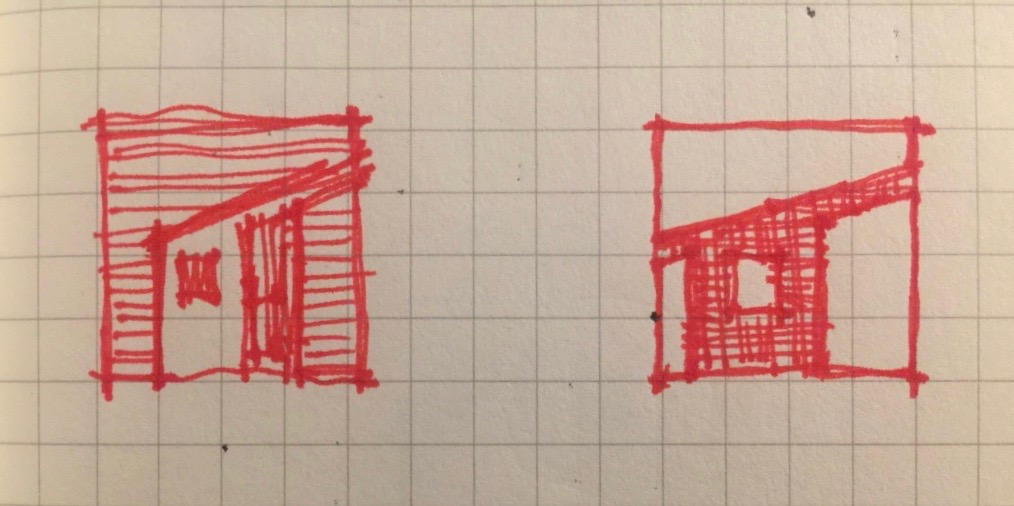
Some of my early sketches show this effort. In retrospect, it appears that I was still having trouble breaking out of the [red] box!

A building stripped down to its essence is comprised of walls, apertures, and a roof. I began with that and sketcched numerous variations. Once I came up with the name, ARCSPACE STUDIO, it occured to me that the ARC could play a role and I manipulated the roof form to reflect a subtle arc.

DbB70bZbSZiQKI%UvoIYSw_thumb_31b2

I felt the logo was somewhat confined so I started playing with negative space. The roof was bisecting the compostion so I omitted the projection on the back side…And on and on. I continued to refine the logo until I was satisified with it and then brought in my multi-disciplined office manager to help take it to the next level. Jennifer is a really good graphic designer who is equally good with color. I presented my logo and together we continued refining it.

cropped-arcspace-studio-logo
the logo before Jennifer

Jennifer had the idea of making the apertures a seperate color and then began to explore several possible color combinations. I agreed with her preferred choice and we made that selection official. There is a level of hidden meaning stemming from these colors. The dark blue background can be seen as the night sky which sets off the stylized profile of the building. The golden color of the apertures reveal light within. Those who know about the profession of architecture can appreciate this representation of the studio, with the lights burning late into the night while the architects inside are busy shaping space!

cropped-arcspacestudiofinlogo-small.png
the logo after Jennifer

During this process I came to understand that, although a critical component, the logo is not the brand. Other necessary components include the name and the tagline. There are stories behind those as well. That’s where we’ll head next!