


AUGUST 2024 ISSUE
“The Sun does not realize how wonderful it is until after a room is made.”
–Louis Kahn, Architect

The colorful Louis Kahn was a pioneering architect and professor. I might add the label of poet, for the way he explained subliminal aspects of architecture. As we’ll discover, even in architectural masterpieces like the Exeter Academy, the construction started out as fairly mundane. This is something made evident in the first of the CA posts, Out of the Ground. An assortment of materials slowly rise from the site and begin to take form. At some point, that form begins to take on life, and the users begin to understand the spaces contained by the forms. For most owners of custom homes that moment occurs when the house is finally “in the dry”. Just as a plant emerges from the ground in a fairly mundane way, it eventually reaches a point where it blooms, and becomes a flower. In the case of both the house and the flower, the catalyst is the sun. This month’s issue addresses that timeframe (of the house, not the flower)!
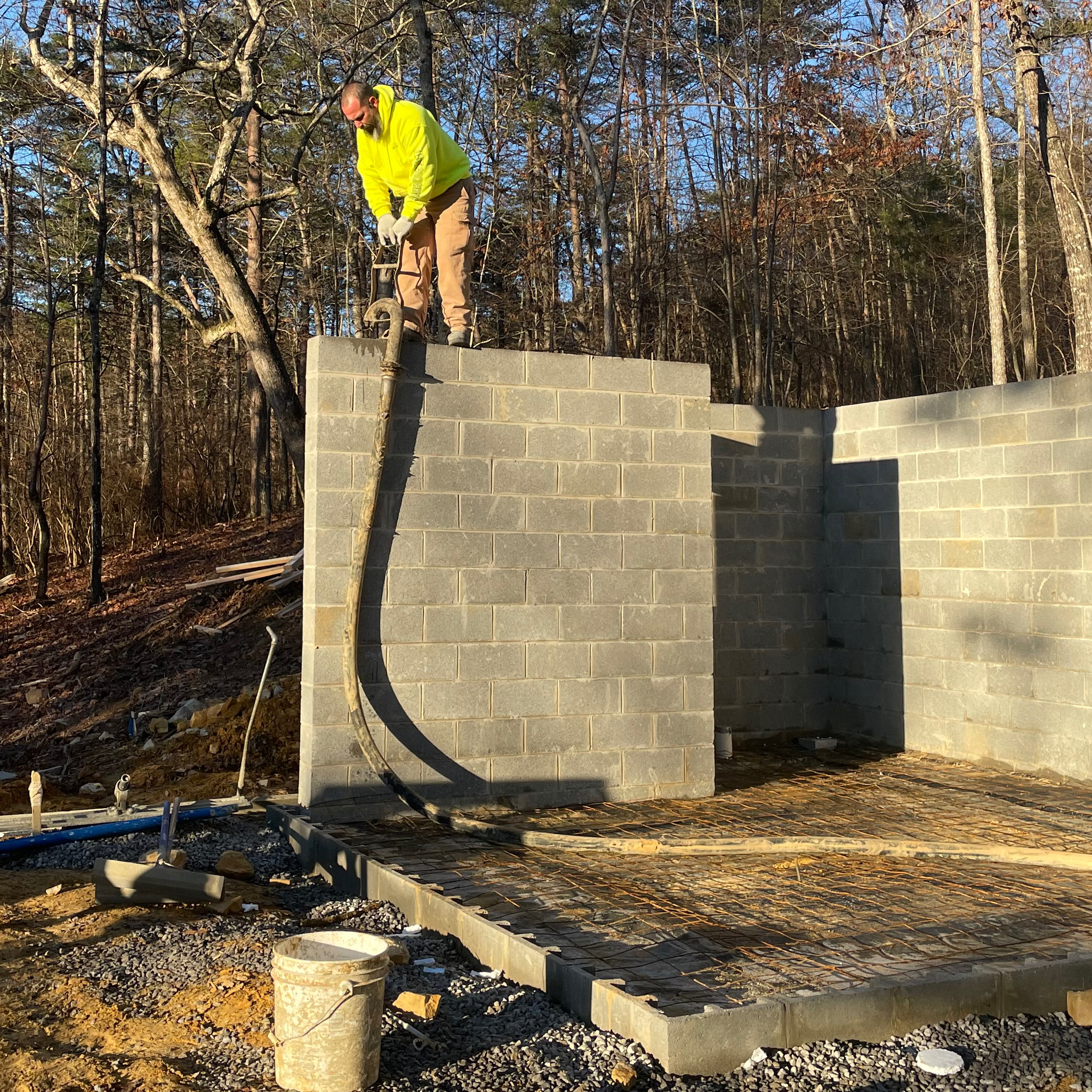
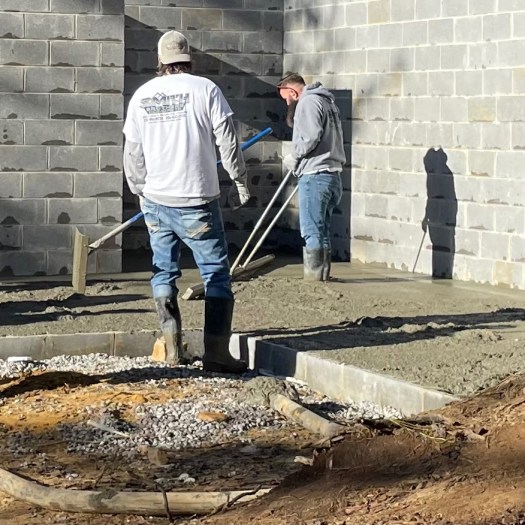
We left the dinky House last month with concrete block walls rising from the poured concrete footings. Shortly after that came the Christmas holidays, followed by a January of rain. During the occasional breaks in the rains, the project crept forward. Be warned: Construction is a maddening series of fits and starts! Since the concrete blocks were designed to hold back the grade surrounding the daylight basement, they had to be poured with concrete and reinforced with steel rebar. The “dormitory” area opened directly to grade, so the floor construction was concrete. Phil, our builder, called in a pump truck and a concrete truck to tackle both of those tasks at once. With the concrete block walls and slab finally poured and reinforced, it was almost time for framing; however, there was one minor task in the critical path blocking the way: the concrete walls had to be waterproofed and backfilled. An easy task, were it not for the rain! The block would almost dry out, then more rain would fall. Soon February was gone. See what I mean, maddening!
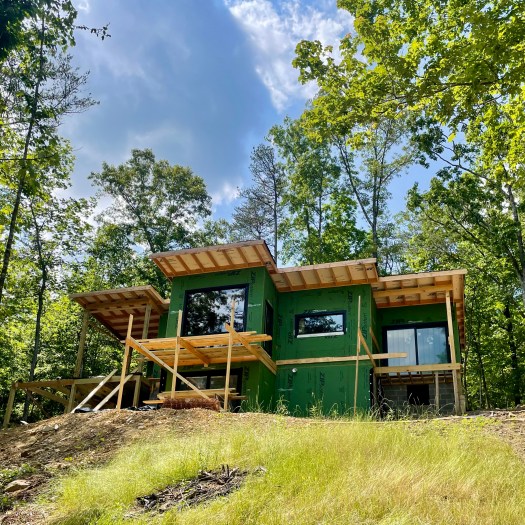
The dinky house used SIPs (structurally insulated panels) for all of the exterior walls. Think of it as a material sandwich: foam insulation between two sheathing panels. SIPs are very strong and provide a really efficient wall, with high thermal resistance and very low air infiltration. They are made offsite in a controlled environment but can be erected on-site quickly, decreasing the time it takes to get in the dry. At the dinky house, all of the main floor exterior walls were SIPs. A little stretch of the basement wall, those not holding back grade, were also SIPs. These basement panels were quickly erected, allowing Phil to begin putting down floor joists and attaching subfloor. After a couple of days, the SIP installation commenced on the main floor. That took a couple of days as well. Once the SIPs were in, that took car of the exterior framing, sheathing, insulation, outlets and conduits. Not bad.

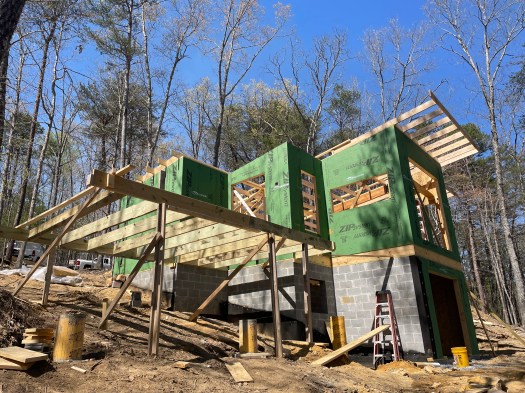
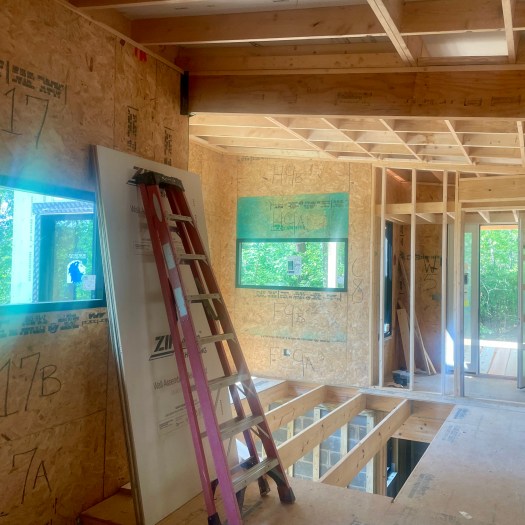
To get in the dry, there was still some interior framing to address, all the windows to install, and a roof to cap it off. Most of this landed on Phil’s key guy, Richard. I’m not sure what job description to assign to Richard. On my project he was a framer. window installer, siding installer, roofer, drywall hanger, finish carpenter, and cabinet maker. In a day and age where it’s hard to find anyone without tunnel vision for their own particular task, it is refreshing to see someone who can do it all, and do it all well. To get in the dry as quickly as possible, the bearing walls were erected first, so that the roof could be installed as soon as possible. Of course, the remaining interior walls needed to be installed as well to clear the way for the rough-in work. Everything builds on something else. There were plenty of dry-in tasks to keep Richard and his sidekick, Hunter busy through the month of April and well into May. By the end of May, we were finally dried in. The sun shone through the forms, making spaces!
BONUS Material:
I have long been interested in SIPS, but there were a couple of perceived drawbacks that kept me from using them on any of my projects. First, I was unaware of any nearby manufacturers. Second, I had only known of them being installed using a costly crane. Third, I was bothered that the sheathing had to be covered inside and out with more sheathing, which seemed like kind of a waste. The last reason was simply that they added too much cost. I’m now convinced that between the offsets, the future energy savings, and the resiliency of the system, that SIPs is a good value, Most of the convincing came from a sole source.
A few years back, I met a gentleman named Rob Clutter, at the annual Home Builders Show in Huntsville. He was with a company called EcoPanels of Tennessee, which was only 120 miles from the dinky House and 180 miles from my practice in Huntsville – same day delivery! There were a couple of things that made his Eco Panels unique. They were fabricated in 4 foot widths, cleverly fitted together, and could be easily installed by the framers, without a crane (at least for the wall panels). In addition, Eco Panels could be sheathed with either Zip panels or OSB. By using zip panels on the exterior we could eliminate the redundant sheathing. I also reasoned that if the exterior SIP walls were all erected, they would establish variations in plate height and make the interior walls much easier to gauge and erect. Using SIPs forces one to plan the power and lighting outlets prior to fabrication. That might be a problem for some, but not for me. All of these details were worked out early on, with shop drawings. About a month after the shop drawings were completed, Rob arranged for me and Susan to visit the plant to see the dinky House dry-fit. That was exciting!
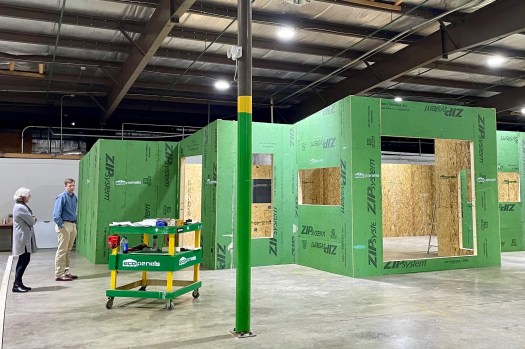
Rob was a great guy to work with. He believed in the benefits of his product and represented it honestly. He had respect and praise for his colleagues who figured out the details and fabricated the panels. He came to the dinky jobsite and gave Phil and the framing crew a crash course in erecting the panels, then hung around until the crew was confident. He was on the other end of the phone line when questions arose, which happens when inquisitive architects are involved.
I learned only recently that Rob passed away unexpectedly while on a jobsite, just a few weeks ago. It was an emotional blow to everyone who knew him – his close family, those who worked with him, those who worshipped with him, and even the customers whom he served. Rob wore a white hat, and he will be sorely missed.
 we shape space