


FEBRUARY 2024, ISSUE 2
“You cannot simply put something new into a place. You have to absorb what you see around you, what exists on the land and then use that knowledge along with contemporary thinking to interpret what you see.”
– Tadao Ando, Architect

Several tasks routinely take place prior to the architect’s involvement. For that reason, these tasks are referred to as pre-design. That is not to say that the architect will not or should not be involved in these early tasks, only that it is typically not part of the architect’s scope of work.
I’ll start by stating what I believe to be plainly obvious: The most important pre-design tasks deal in some way with the building site. As we’ll explore further in the next installment, Parti’ Time, the selection of the site, more than any other factor, defines the architecture. The slopes, the views, the positions of the sun, the proximity to boundaries and neighbors, all of these site-related factors, can influence how the house will be arranged, planned, and formed. Having said that, It is not a given that the site will be inform the house design. Houses are commonly designed with no regard to their site, if they even have a site when designed. Such a house may provide adequate shelter and may even exhibit nice features; however, it will not reach its full potential. It may be shelter, but it unlikely to rise to the level of “big-A” Architecture.
Finding the right site is hard! I empathize with my clients who genuinely struggle to find the perfect site. Once Susan and I decided that we wanted to build, as discussed in the An Origin Story post, we were faced with a couple of significant questions – What? And Where? The What will be answered in future posts, The Where is addressed here.
Susan and I knew that we wanted a couple of acres somewhere along the Little River. I was thinking of the West Fork, and the first site we found was on the West Fork, just north of Mentone. It was a beautiful site that sloped gently to the river. It had a nice mix of hardwoods and pines, as well as some beautiful native rhododendrons. Strangely, there had been very little development in this area, at least near the river. As it turns out, even though Little River runs on top of Lookout Mountain, it floods periodically and the majority of this site was in the floodway! We also learned that the nearest waterline was a half mile away. Strike 1…..and lesson 1: Do your due diligence!
Next we found some property along the East Fork. I had persued the West Fork because I thought the East Fork was too narrow and would more closely resemble a stream. When we visited the area I was happy to be completely wrong. Below Lake Lahousage the East Fork was every bit as striking as the West Fork. And from all indications, the Owner was ready to sell, offering to throw in lot 4 along with lot 5. Who can resist a BOGO? The only problem was that one had to cross a ravine to get to lot 5. Access was just a hard hike by foot but would be too steep for a car, not to mention a cement truck! I called in a sitework excavator who gave me a jaw dropping estimate for the labor and materials required to cross the ravine and another site was eliminated. Strike 2…..and lesson 2: Make sure your site is accessible!
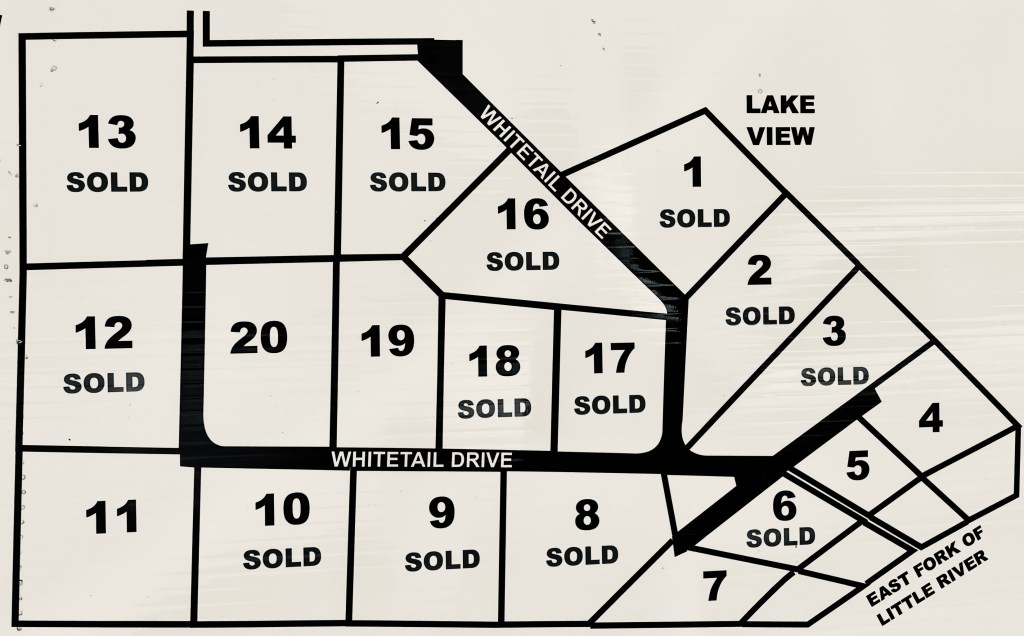
We didn’t know it at the time, but what became our actual building site was just a couple hundred feet downstream, Lot 7. This site was the most beautiful of all we had seen. It had good vehicular access and sat high above the floodway. It was relatively flat near the gravel entrance road but steep as it neared the river. Utilities were close by and could be made to work without too much trouble. So, after a little more due diligence, we contacted our Realtor and made it happen. It was the perfect site for us and our needs . Homerun!

Putting on my architect’s hat for a minute, I can tell you that rarely has a client come to me without having already secured their building site. That’s too bad. I think that architects can offer a lot of useful insights into the site selection process. If you do select the site, just make sure you check all of the possible restrictions – floodways, sloped development, zoning, neighborhood HOAs, and the like.
Home Owner Associations covenants are often overlooked but can have a big impact on the design of the house, particularly if you want a compact design or if your aesthetics lean contemporary. In the case of the dinky House, the site we purchased is in a “neighborhood” which did have covenants. This caused some hiccups since the convenents required that the house be 1,130 square feet or larger (I’m not sure how they arrived at that number.) After doing some early schematic design, I felt I could get everything we needed in about 900 square feet. Susan felt we needed more space so that we could house more people (grandchildren really!). Of course she was right, and the “dormitory” was born, which got us over the square footage hump. Fortunately there were no objectionable design restrictions, as our taste leans contemporary.
I should point out that if you finance your project through a lender, you may need to provide a fair amount of up-front information. In addition to financial statements you’ll likely need either a bid or a good faith estimate from a builder. Obviously that requires knowing who your builder will be before your house is even designed, or it requires that you work with the architect at least through the schematic or design development phases. That can be pricey if you’re not certain that you want to build. This is a chicken-and-egg dilemma – the first of many.
Every project will have its own unique pre-design tasks. This post highlighted some of ours. Hopefully it has shown that the site, and all of its parameters, are of paramount importance when one is considering building a house. Since I happen to be an architect, I didn’t really have to decide when to reach out to an architect. Assuming that you’re not an architect, you’ll want to start out by really thinking through what kind of house you want and roughly what you’re willing to spend to get there. Your architect can help you flesh these things out as the design is developed. That’s the topic of the next post, Schematic Design: Parti’ Time.
BONUS Material:
If you look carefully at the Realtor’s map, you’ll notice a line running parallel with the Little River which bisects lots 4, 5, 6, and 7. This caused a great deal of head scratching. Was it a property line? Was it a building setback line? Neither our realtor nor the selling agent knew what it was. Eventually I found out in conversation with a local sitework excavator, and later his story was retold by the civil engineer of record for the subdivision. The line identified the location of the dinky Railroad, which inspired the name “dinky House,” now affectionately known simply as “the dinky”.
 we shape space
2 Replies to “pre-design: IN PLAIN SITE”