epilogue: NEVER REALLY FINISHED

DECEMBER 2024 ISSUE

“Architecture is like frozen music, and the role of the photographer is to make it sing.”

            Ezra Stoller, Photographer

Early on, a vision of the architect’s project begins to jell. The design process is all about developing and documenting that vision so that it can ultimately be translated into built form. At least for me, the vision includes not only the building but its contents as well. In many cases, the owner develops a very different vision and furnishes the house in a way that taints the architect’s perceptions. (Perhaps another example of arrogance on the part of the architect, but it remains true)! This discrepancy in visions may explain why, in some cases, the architect chooses to photograph a project before it is furnished. In other cases, the visions are in closer alignment and the architect chooses to photograph the project after it is furnished. A well-appointed house enhances the architecture, and good photography can capture that. Great photography goes even further, by capturing the house’s underpinnings, or what Francis DK Ching calls “form, space, and order”.
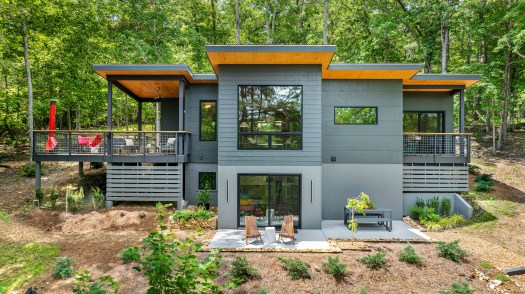
Higher Perspective photograph of the dinky House

The contents within the house area referred to as FF&E (furniture, fixtures, and equipment) and are typically outside of the scope of the architect’s work. Owners and/or interior designers are the ones who normally deal with these things. I once heard FF&E explained this way: If you pick up a finished house, turn it upside down, and shake it, whatever falls out is the FF&E. The part you’re shaking is the architecture.

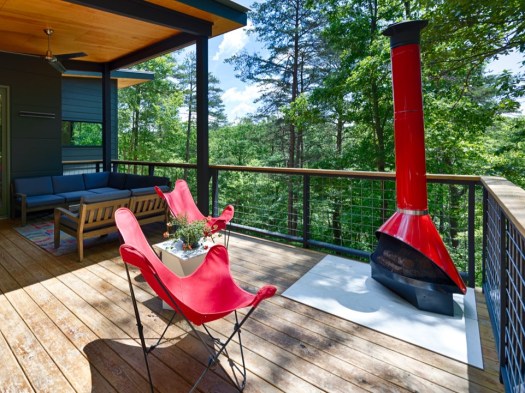
In the case of the dinky, most of the FF&E was new, since we didn’t move. We still live in the BirdHouse during the week. So, Susan and I (but mostly Susan) spent months collecting furniture and furnishings. We also seized the opportunity place a couple of classic pieces that had been gathering dust for decades. One was a fire-engine red funnel fireplace that Susan won in a raffle in the 70s, which was converted to a chiminea and now sits proudly on the deck. Another was a recently restored classic Dr.Pepper machine salvaged from my grandfather’s welding shop, for which I carved out a niche near the stair. I modeled these things and placed them, along with the other furniture, in my house model so we could visualize various options and scenarios. When designing any custom house it is important to make sure the furniture works. In a small and efficient house, it is especially important.

Dr. Pepper machine
fireplace

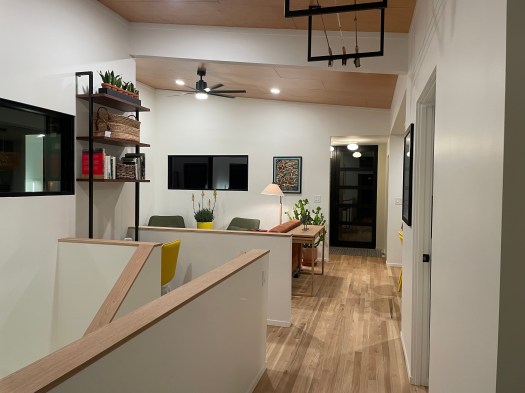
Assuming you want your house photographed, deciding when to do it is tricky. You will probably think “once it’s finished”, but when is that? I would contend that all projects, the dinky included, are never really finished. There is always a dangling punchlist item that was not checked off, or a piece of furniture to add, or some artwork to frame and hang. At some point, however; even though it’s not completely finished, it’s finished enough! At the dinky, that time was summer. I hired Urban Lens to photograph the interiors and Higher Perspective for drone shots of the exterior. We’re quite happy with the results. I think they show the house well, and give the viewer a pretty good sense of the spaces. Interestingly, they also make the house look larger than it really is, and than its name suggests. Ah, the magic of photography!

The kind of project that we originally embarked on may have reached a point where the house is photo-ready, but it will take more time for the site to reach the same point. In the last few months our focus has moved back toward site improvements. In addition to landscaping, we’ve been thinking about the benefits that a small carport would offer. Primarily it would provide shelter for an EV that Susan has been eyeing. It could also provide a convenient place to store yard tools. If sited at a lower elevation than the existing parking area, it would to allow a more accessible path to the dinky. What I’ve dubbed the dinkier carport is now in the preliminary design stage. I suspect that we’ll come up with other “necessary” improvements along the way. In other words, the dinky project is not really finished, and may never be!

THE dinky CHRONICLES, on the other hand, are finished!

dinkier Carport

BONUS Material:

I began THE dinky CHRONICLES in January of 2023. This, the final post, is being published in December of 2024. The design and construction, at least for our original scope of work, is now behind us. We have experienced weekend living in this cabin, on this site, in all four seasons. The verdict is out, and we love it!

As established in the initial issue of THE dinky CHRONICLES, Prequel: AN ORIGIN STORY, the dinky House is, at its core, a fishing cabin. The architecture of the dinky was inspired both by this function and by its river-focused site. The Little River is a wild river and the fish in it have not been stocked. They are native. The redeye bass, for example, have inhabited these waters for millennia. In short, they belong there. I catch them, appreciate them, and then I let them go. I want these beautiful and unique fish to remain for future inhabitants to the dinky – my grandchildren, and theirs.

A dinky bass out of the Little River.

construction administration 5: WHEW!

NOVEMBER 2024 ISSUE

“A doctor can bury his mistakes but an architect can only advise his client to plant vines.”

            Frank Lloyd Wright, Architect

The Architect and the Owner are often given the benefit of the doubt during construction. Curious neighbors may say, “What is that framing on the side of the house all about?” Relatives may ask “Are you really going to leave it painted black?” After construction, however, the juries begin to render their verdicts. If the architect’s vision is wonky, if the program is too restricted by owner, or if the contractor is not up to par, this is where it will all become evident and you may be forced to plant vines! I like to think that vines are not necessary on the dinky House!

Dec. 2023 – “Ready or Not” Move In

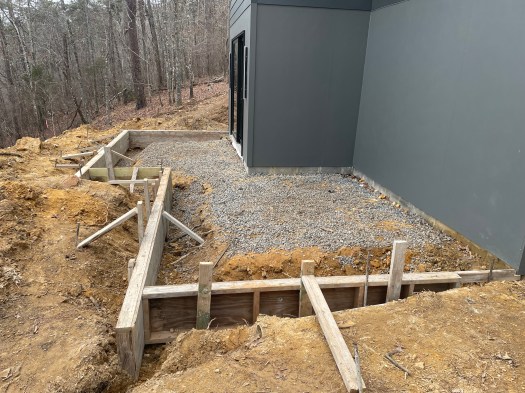
Whew! This is the final post following the construction administration phase – the time following it to the point of “substantial completion.” The last post, Seeing the Light, took us right up to the 2023 Christmas season. The original construction schedule had us scheduled to be complete by the end of October, and I had taken off the week between Christmas and New Year’s for the move in. As October drew closer and we still had a good ways to go, I was forced to go back to the bank and tell them I needed an extra couple of months. This happens …. a lot. By the time Christmas arrived, project completion was close enough that we opened our presents, ate our dinner, woke up the next day and started the move in. The appliances had not been installed, we still had a little tile left, the shower door had not been installed and the final punchlist had yet to be written. We also added a concrete patio leading from the Dormitory. This was a “change order” that I presented to Phil late in the process.

Jan. 2024 – Rear Patio
Dec. 2023 – Tile Splashes

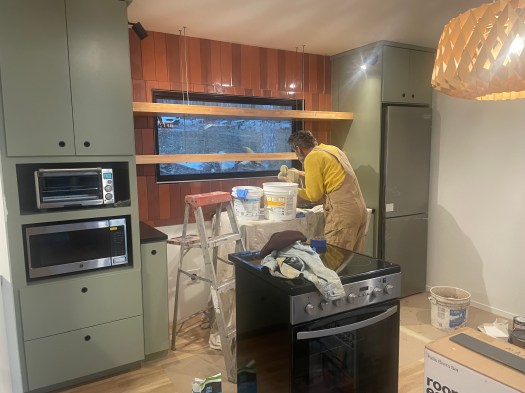
The countertops had just been installed, so the tile setter was working around me as I was putting together furniture in the middle of the Living and Dining area. The glass guy slipped in and installed the shower door. Susan kept busy cleaning the place, which is something that is usually subcontracted. Susan had been ordering furniture for months and storing it in our garage and a small rental storage unit nearby. Susan knows that I actually enjoy putting furniture together. She blessed me with plenty of enjoyment, We kept busy from the crack of dawn to the dead of night for the remainder of my “time off”. The transformation was pretty amazing.

Jan. 2024 – Move in mostly complete

Time for me to generate a belated punchlist. A punchlist is simply a room by room listing of all the things that are not complete, not working, or not to the level of refinement that should be expected. Ideally, the architect would do the puchlist when the builder thought he was substantially complete. Once all the punchlist work was completed, the owner could begin the move in. My punchlist was relatively short, partially because we did a lot of it ourselves during that week. I actually like doing things like installing door hardware, toilet accessories, and that kind of thing.

There are a couple of other things pertaining to construction administration worth mentioning. During the course of the dinky House construction, because of my dual archictect/owner role, I was at the jobsite a lot! Sorry, Phil! In my day-to-day role as just the architect, I usually visit a jobsite just enough to stay abreast of the progress of the job. That’s normally a couple of hours every other week, but sometimes more, depending on what is or is not happening. I’m there to provide another perspective for the owner and to make sure that the vision I documented on paper ends up in brick and mortar. We call these visits “field observations” and not “inspections”. It is not the responsibility of the architect to catch every mistake the builder may make or to tell him when and how to construct the project. The means and methods are up to the builder. I normally spend whatever time is required to carefully look over the jobsite, alert the builder to any deviations from the contract documents that I encounter, answer any questions the owner or builder may have, and gauge the progress so that I can make sure that the owner and I have decisions made so as not to impede progress. I normally follow these visits with a Field Observation Report. Depending on the agreement, I often review the builder’s pay request to make sure they are in line. The builder is fairly entitled to be compensated promptly for work completed and for necessary material deposits, but should not request funds for work not completed. There are rare occasions when a builder is borrowing from Peter to pay Paul. Architects also make sure that a project is closed out correctly – punchlist completed, warranties turned over, and liens releases are signed. The architect is also coordinates change order to make sure they are fair and equitable. Spread out over the course of construction, there is quite a bit of effort in this phase, which is why it is normally about 25% of the total architectural fee.

So, back to the dinky House. It seems like we were finally finished, but were we really? That question will be answered in the final issue of the dinky Chronicles. Join me next month for Never Really Finished.

BONUS Material:

In the summer of 2009 my youngest daughter was preparing for college. She and our other daughter, already in college, decided that Susan needed someone other than me to nurture. Specifically, they felt she needed a puppy. The girls hounded Susan for weeks (pun intended) until she caved. My only responsibility with the new puppy was to name him, which I did, after the legendary architect LcCorbusier, or Corbu for short. I anticipated that Susan would fall hard for the cute little puppy as he peered out from his tiny crate. What I did not anticipate…. was that I would too.

Corbu quickly took over the house, then he claimed the yard. He also commanded a roving boundary, within sight or earshot of Susan. She knew him best and was the first to channel his often random thoughts, although I quickly learned the art as well. Susan was the Momby and I was simply Dad. Anytime we left the house, Corbu would jump in his crate, knowing that we might take him with us. We often did. He was the best traveler of all the children. He was so quiet that sometimes we would look in the crate to make sure he was still there. Of course he was, but he would occasionally slide under his bedding, as if he had disappeared – the Amazing Corbini!

Ruler of the House
Protector of the Yard

Corbu loved to play. He would take squeaky balls to the top of the stairs, drop them, then go chase them down. If he was downstairs and Susan or I squeaked a ball upstairs, he would immediately run up and grab the ball with his mouth. He could tell them apart by their squeaks! Even though he never reached his goal of 12 pounds and had to take ten steps to match my one, he loved to “go for the walk”. Rarely did a day pass that we did not roam the neighborhood together. Neither wind nor rain nor dead of night could stop us from our appointed rounds. He was a really clever dog and could navigate the neighborhood well, and even turn for home when he started to get winded. Corbu liked to explore and go on hikes with us. One of his last was to the property where construction of the dinky House was about to begin.

To our great sorrow, Corbu died unexpectedly during the Summer of 2022. We had anticipated he would be laying claim to another place, but it was not to be. It did not feel right for Susan and I to be enjoying the dinky without his presence. We decided to commission a pop art poster and gave it the most prominent spot in the house. I know it’s weird, but It seemed right. It’s our tribute to the best dog ever!

Corbu: 2009-2022

design development: HOW IT WORKS

APRIL 2024, ISSUE 4

“Design is not just what it looks like and feels like. Design is how it works.”

-Steve Jobs, founder of Apple

I really appreciate this quote by Steve Jobs. His comment about design in general could be said of architecture specifically. It succinctly describes the first two phases of architectural service. If the schematic design phase determines “what it looks and feels like”, then the design development phase determines “how it works”.

In this post we’ll delve into how it works. Design development is the second of the five phases of service that architects typically provide. Using the dinky House as a case study, we’ll explore the architect’s process, or at least my process. In this phase we advance the plans, more precisely place the house on the site, select the primary building materials, and decide on the major building systems. My toolbox containing paper and pens is supplemented during this phase, and computer modeling is added.

space plan at the end of design development

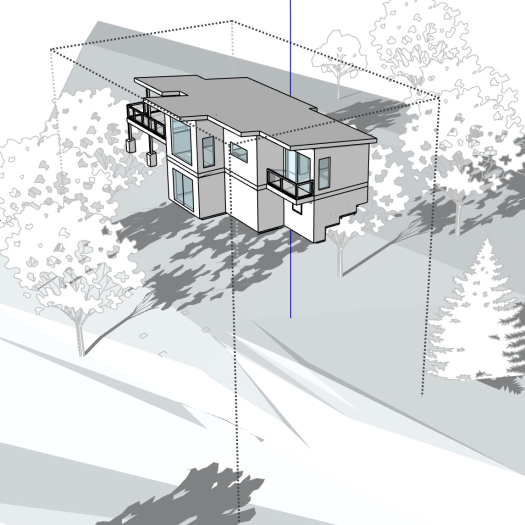
I use the information gathered from the schematic design phase to produce a basic model of the house, and I gather whatever site information I have to build a basic model of the site. With that, I can more precisely locate the house on the site, as a 3d object on a 3d site. I can move and rotate the house to get it to both the right location and at the optimal elevation. Sometimes this is tweaked in the field but this technique yields pretty good results. In the case of the dinky house I commissioned a topo of the building area, as determined in the schematic design phase, made the models, and then played around with them for a while. There was a 75′ front yard setback imposed by the HOA. I also knew I had to work outside of the floodway, which extended to the dinky line. Otherwise, the placement of the house on the site was determined by architectural and logistical reasoning.

house to site placement

Architecturally I wanted the house to be of the hill, and not on the hill (FLW would be proud!), so I planted it in the bank of the hill. I positioned the house to gather the best views possible, short of clear cutting to the river. We were content with view corridors during the summers, until the fall begins to thin out the woods. But views are not everything. One of the cool things about the dinky site are the soothing sounds of the river rolling over the nearby shoals. So we positioned the house to maximize our sensory enjoyment of nature.

Logistically, the house needed to parallel the contours to minimize sitework. The contours suggested that the facade facing the river be oriented Southeast. Knowing that the best passive solar orientation would be South, I twisted it a bit to get it closer to South, while still straddling the contours. Easy access to the jobsite area, and later parking, was available on the north side. Utilities were also located on the north side, except that city sewer was not available. The logical place for a septic tank and drainfield was on the low-slope east portion of the site.

The house model is a great tool for exploring exterior materials. I typically like to mix a couple of different facade treatments. For cost and ease of maintenance it’s hard to beat fiber cement lap siding. So I began with that but I was not sure what to pair it with. After considering a lot of options, I decided to leave it open for the moment, to allow for additional study. (Sidenote: The design development phase advances the design, but it is not necessary to know everything about the materials and systems at this stage. It’s okay for some things to remain undecided, or even change, as the project develops.) The low sloped shed roof really called for a metal roof. I’ve always liked the corrugated metal roofs that cap so many rural barns, and decided to use it. The exposed structural components are painted wood. The deck boards, ceilings, and soffits are sealed wood.

Then there are the interior materials. As opposed to many cabins lined with heavy stained wood walls, I chose to use drywall. I have found that it can be a sculptural material that can also be light and airy. I did use some wood paneling but it is painted and used only in a couple of targeted locations. I’ve always liked strip oak wood floors and decided to use them throughout the main floor. Luxury vinyl tile is used throughout the lower floor for its durability and the variety of colors and patterns. The ceilings are a combination of drywall (mostly on the flat ceiling) and sealed plywood (mostly on sloped ceilings), providing continuity between the inside and the outside.

The structural systems is conventional for the most part, consisting of concrete footings, a basement floor slab, CMU basement walls, and wood framed floors and roofs . The walls however are SIPS, a sort of sandwich panel of sheathing and foam. When used with spray foam and rigid insulation board on the roof, these materials provide a very efficient thermal envelope. The heating and air conditioning design utilize high efficiency mini-splits, supplemented with an ERV/dehumidifier and exhaust fans to keep the air fresh in the tight thermal envelope. The plumbing system is conventional except that it feeds primarily WaterSense fixtures and fittings. Hot water heater is heated in a simple high efficiency tank and recirculated by a pump for “on demand” control. The electrical system is also fairly conventional, and powers a combination of LED light fixtures and ceiling fans.

systems exploration includes structural, HVAC, and electrical

Knowing what it looks and feels like, as well as how it works, we are now ready to advance to the next phase…..and the next blog post. Be on the lookout for – construction documents: BLUEPRINTS.

BONUS Material:

With commercial projects, Architects quarterback a whole team of professionals, including civil engineers, landscape architects, interior designers, structural engineers, mechanical (plumbing & HVAC) engineers, and electrical engineers. That is not the case for the average custom home. Architects often perform at least an abbreviated version of the tasks carried out by most of these design professionals. Sometimes an Owner will retain a landscape architect. or an interior designer, and sometimes an Architect will retain an engineer for a limited scope of work.

On the dinky project I was comfortable handling just about every task, with one exception – color selection. If you visit my current house, you may ascertain that my favorite color is white. I love the clean, crisp feel of white surfaces, as well as the play of shadow and light that white surfaces enhance. Susan too has a fondness for white……or so I thought, until she requested “a little color” both in and out at the dinky. I suddenly felt deficient. Fortunately I knew a couple of exceptional interior designers who had done a masterful job on a couple of the firm’s custom homes. So Susan and I worked with The Design Collaborative to select the right colors. They also had some great ideas pertaining to materials and textures, ideas which took the project to the next level. Thank you Heather and Hannah!

one of the color boards generated by TDC